A Life Not Measured
Week One
Calvin Drake woke to birdsong and the smell of wet earth.
Real birds. Real earth. It was incredibly disorienting.
Green light filtered through a humid canopy. His body ached as if gravity had thickened during his sleep. His breath fogged in the cool air. Somewhere water dripped, slow and rhythmic.
“You’re safe,” a voice said—steady, patient. “Don’t rush.”
The figure who stepped into focus looked carved from calm: mid-thirties, dark curls tied back, loose hemp clothes, bare feet. No badge. Nothing corporate.
“You’ve been in cryostasis a long time,” they said. “Your vitals are good.”
Calvin’s throat felt like paper. “How long?”
“One hundred and two years.”
He laughed once, cracked. “Where’s my legal team?”
“My name’s Jun, we’re distantly related” they said. “I’ll be helping you get oriented.”
They handed him warm broth—earthy, gingery, faintly floral. His fingers shook. Outside the greenhouse came no hum of traffic or jets. Only wind and insects.
He strained for the missing noise—the soft thrum of servers, an assistant waiting for instruction. Nothing. Silence had a weight he’d never noticed.
When he could stand, Jun gave him linen clothes. The fabric was so soft it frightened him; things that delicate had never survived his world.
“Where are we?” he asked.
Jun gestured toward a vine-thick path. “We call this place Solace.”
As they walked, he caught himself saying, “Schedule a debrief,” out of habit. The air didn’t answer. Jun only offered a small, amused smile.
– – – – – –
That night Jun brought him to a communal meal beneath flowering trellises.
No staff, no menu, no transaction.
A child offered bread. Someone passed roasted roots. The table buzzed with gentle talk—no screens, no music pushing tempo.
“I’ve no cash on me, can’t pay,” Calvin whispered.
“Neither did anyone else,” Jun said.
He frowned. “The economy must have rebounded.”
“There’s no economy,” Jun said softly. “Not the kind you mean.”
He scanned the easy generosity and felt an old itch—where was the hierarchy, the ledger, the gatekeeper?
No one. That unsettled him more than hunger ever had.
Interlude: One Hundred and Two Years Ago
He had signed the cryo-agreement the week Manhattan drowned.
Protesters hurled slogans and eggs outside the tower. Security guided him through gasoline-scented runoff. Inside, the lobby glowed antiseptic white, air scrubbed to chemical perfection.
Holographic tickers streamed losses down glass walls. His company’s emblem shimmered above the boardroom table—an oak leaf rendered in gold. Branding that pretended to be wisdom.
“You’re running,” his son said, blocking the doorway. The boy’s suit was too big, sleeves rolled. “You could help fix this.”
“I’m hedging,” Calvin replied. “Preserving value.”
His son’s eyes shone with anger and something like love. “Dad, please—”
But technicians were already sealing the chamber. Frost spread across the glass. Through it he saw his son mouth the words that would haunt his dreams: You’re just running away.
He’d expected to wake to a market ready for conquest—
not a world that had outgrown conquest.
Week Two
Each morning Jun walked him through Solace—terraces of fruit trees, water channels whispering beneath solar glass. Children chased sparrow-sized drones; elders gathered herbs into woven baskets.
“Who keeps this running?” he asked.
“Everyone,” Jun said. “Care rotation. No permanent jobs. Skills passed around.”
“And this works? Without profit?”
Jun nodded. “Automation and open design gave us abundance. Sharing kept us alive after the Disbanding.”
“The Disbanding?”
“When the old systems defaulted,” Jun said. “Nations, corporations, currencies—one by one. People stopped playing.”
“Stopped playing what?”
“The game where everything had to earn permission to exist.”
“That’s not sustainable,” Calvin muttered.
Jun gestured at terraces heavy with fruit. “Apparently it is.”
They crossed a plaza where children coded robots under the trees. A tiny drone offered him a pear with careful metal claws.
“So no one hoards?” he asked.
“We still feel want,” Jun said. “We just learned not to feed it.”
That night they ate in a rooftop garden while lanterns swayed in the breeze.
“People just gave it up?” he asked. “Ownership? Profit?”
“It broke,” Jun said. “People chose something else.”
“It sounds like communism.”
Jun smiled. “Labels were luxury goods. When everything collapsed, no one bothered sorting ideas by the old categories.”
Week Three
The need to build something gnawed at him.
During breakfast, he blurted, “We could run a pilot—optimise workflows, reintroduce competition. Measure output, reward innovation.”
A teen frowned. “Compete for what?”
“Efficiency. Prestige.”
“We already have what we need,” she said, and the conversation drifted away. Jun gave him a sympathetic smile that hurt more than criticism.
He posted a manifesto—Rekindling Ambition in Post-Scarcity Societies.
One reply: We already have more than enough.
He walked the gardens afterwards, invisible. People greeted him kindly, but no one deferred; no one needed him. The realisation hollowed him out.
That evening he passed lamplit houses where people read aloud, played soft music, shared soup and laughed. The air smelled of thyme and woodsmoke.
He remembered the old boardrooms where laughter usually meant someone had won.
Here, it was just… laughter. Light, wandering, not aimed at anything.
It unsettled him how easily people moved around him. No glances waiting for his verdict, no tension in the shoulders. For the first time he could recall, he wasn’t a presence—just a person.
– — –
He found Jun tending herbs by the stream.
“I built a logistics empire,” Calvin said. “Fed millions.”
Jun didn’t look up from the herbs. “But did you build it? Or did the hundreds of thousands of people working beneath you build it while you stood at the top of the pyramid?”
He exhaled. “I know. I told myself I was steering the ship, but they were the ones rowing. I just… never said it out loud before.”
He stared at his hands, surprised by their unsteadiness. “Then… why wake me at all?”
Jun met his gaze. “Curiosity. Family. Nobody gets left behind, not anymore.
He didn’t answer. He just let the words find a place to sit.
Week Four
A scrap of sea-blue cloth appeared beneath his door. One word in careful ink: today.
He nearly ignored it—unstructured time still felt threatening—but Jun arrived with a bundle of undyed fabric.
“You said your sleeves were too short,” they said. “Come make something that fits.”
The dye circle gathered in a sunlit courtyard where rain had darkened the stone. Buckets of colour steamed. Someone stirred a pot with a branch-like stick, the surface swirling into galaxies. Children carried dripping cloths past him, blue water trailing from their elbows. The air smelled of vinegar and something green and feral.
Jun showed him how to fold and pinch the fabric to make waves. “Let the pattern breathe,” they said. “Let the cloth remember it’s plant matter.”
“That’s some high-level hippie talk right there,” he murmured, fingers constantly wanting to control.
A woman with silver-streaked hair, hands stained deep violet, glanced over and hid a quick smile.
They worked in silence. When Jun helped him lift his cloth, gentle bands of colour emerged.
Later, a boy leaned close. “My grandpa says you owned countries.”
“That’s an exaggeration.”
“He said you froze yourself to get richer.”
Calvin paused. “That part’s true.”
The boy studied him. “Are you richer now?”
Calvin looked around—the laughing mouths, stained hands, soft flags of drying cloth, Jun sitting cross-legged in the sun.
“I’m starting to learn what that really means,” he said.
The boy nodded and ran off.
Three days later he drifted toward a shaded workshop by the stream, drawn by a chorus of frustrated sighs. A handful of kids and a couple of older volunteers were crowded around a water drone lying on its side. The intake filter was half-removed, clogged with wet leaves and grit.
“It’s not the battery,” Calvin said before he could stop himself. He crouched beside them, nodding at the filter. “It’s choking. You’ve got the intake packed solid.”
They looked up. A boy wordlessly offered him a small screwdriver, hope flickering across his face in a way that caught Calvin off guard.
He didn’t take over—just pointed. “Loosen that bracket. Yeah, that one. Pull the filter out slowly or you’ll tear it.”
Small hands worked carefully while he supported the housing. A moment later the filter came free with a messy slurp, debris spilling onto the table.
“Try it now,” he said.
One of the kids tapped the starter. The drone hummed, then pushed out a steady jet of water across the workbench. A few people jumped back; someone laughed in relief.
The kids grinned at each other, the tension draining from their shoulders. Calvin felt something shift in him too—quiet, unexpected, almost like pride, but gentler.
A little girl tugged his sleeve. “Someone said people used to trade numbers for things. Is that real?”
“Yes,” he said softly. “We called it money.”
She tilted her head. “But why? What did it even do?”
He hesitated. “It was supposed to make things fair. Mostly it didn’t.”
That evening Jun found him rinsing lichen from his hands in the stream.
“You’re changing,” Jun said.
“I’m going soft.”
He smiled to himself. For the first time, softness didn’t feel like weakness.
Week Five
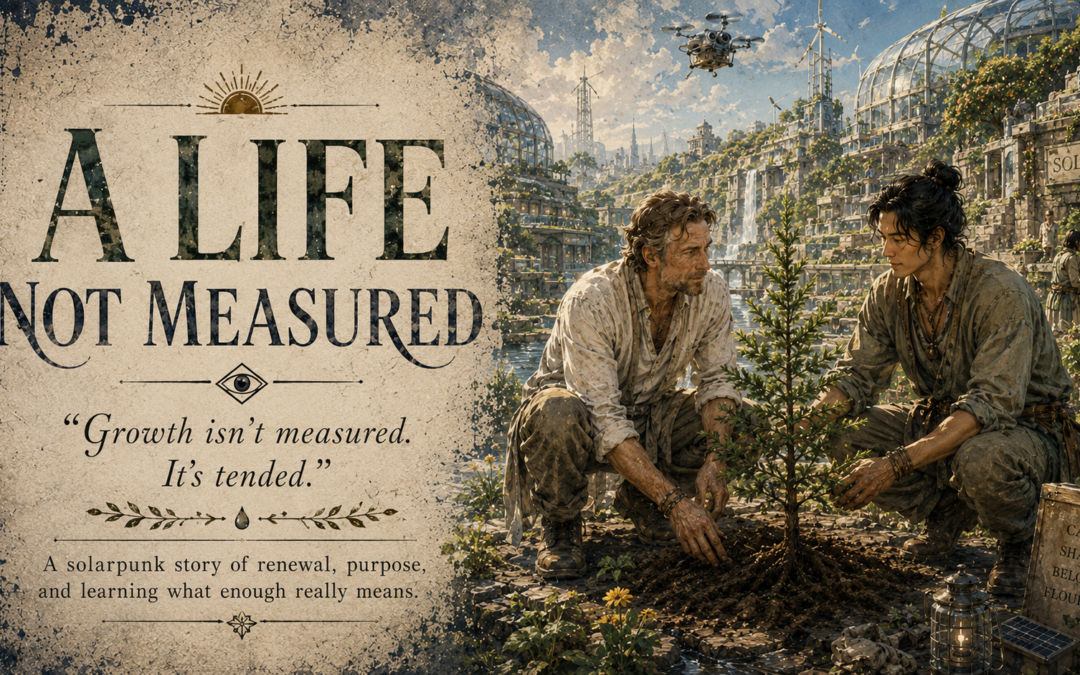
Planting day opened in a shared hush, the grove damp with the scent of bark and mint. Seedlings waited in baskets along the path, each wrapped in compost cloth. A few young trees bore hand-written affirmations tucked into the twine:
Grow steady.
The sun will find you.
You belong here.
A Japanese maple had a tiny haiku pinned to its basket:
Wind-torn limbs still rise;
Sap remembers how to climb
even after storms.
No speeches. No leader. Just tools, hands, and the work that asks the body to be present.
Calvin hovered at the edge until a teenager with grease-slick hair and a polite impatience pressed gloves into his hands and pointed with her chin at a coil of hose. “If you’re standing, you’re volunteering,” she said. “Water’s there.”
He grinned despite himself and obeyed.
Jun was already kneeling near the stream, loosening soil with a flat blade like a conductor trying for the softest note. They didn’t look up when they spoke. “Find a spot that feels right. Sun in the morning if you can. Trees are like us—they like a good reason to get up.”
He walked until the noise of everyone else faded to a comforting murmur. A clearing opened where light came in a broken pattern through leaves, the ground gently sloped toward the water. He felt the sense of here in his chest. It surprised him.
The redwood sapling was no taller than his waist, bright needles trembling minutely as if aware of its own effort. He dug a hole larger than he thought he needed and hated how instinctively he framed that as “slack.”
He set the roots in and whispered, because everyone else seemed to be speaking that way today. “I named companies after your family,” he said, one palm cupped around the delicate stem. “Redwood Dynamics. Sycamore Holdings. Sequoia this, Oak that. I wore your names like trophies. It was branding. I’m sorry.”
Wind moved through leaves. Somewhere upstream, water tapped stone. He didn’t expect absolution. He didn’t even expect understanding. He just felt the truth move through his voice and into the dirt.
Jun arrived beside him quietly and poured water until the soil sagged around the roots. “Press your hand in,” they said. “Flat. Let it feel you.”
He did. The earth was cool enough to steal the heat from his palm, and then—strange—give some of it back. He kept his hand there a few seconds too long.
When he looked up, Jun’s eyes were soft. Not forgiving exactly. Witnessing.
They stood in a silence that had weight and shape. People nearby hummed without words. A child was tasked with collecting rainwater from buckets and poured it with an exaggerated care that made the grownups smile, no one correcting the slow spill, just waiting.
Afterward, he coiled the hose and lingered by the sapling, unwilling to leave it alone in its newness. He thought of how quickly he had learned to celebrate openings—the ribbon, the camera, the temporary high of being seen. He couldn’t remember ever staying for the maintenance.
“See you in the morning,” he murmured to the tree, feeling foolish and not minding. “We’ll check the soil together.”
—
That evening a basket waited outside his door: dried citrus peel in a fragile jar; a spoon carved from something that might have been a fruit tree, the bowl of it worn silk-smooth by hands; a small jar of ginger salt that smelled dangerous and joyful. No note. No signature.
In his old life, surprise gifts had been instruments—leverage wrapped in tissue paper. He examined the basket as if it might have a second meaning tucked under the cloth. There wasn’t one.
Later, he found a stack of hand-bound books on his stoop, threads neat as stitches. Essays, small histories, some stories annotated in margins by different hands. He carried them inside like a fragile animal and chose one at random: The Dispossessed
He read by lantern light, the glass popping now and then as insects tested the flame and thought better of it. A note scrawled in one of the margins wedged itself in the space behind his ribs:
“Abundance doesn’t come from taking more.
It comes from knowing when you already have enough.”
He fell asleep with the window open. The night air smelled faintly of mint and wet stone.
Week Six
Jun knocked at dusk, which in Solace meant a bell tone from the ridge and the sky blushing toward indigo. “People are having a small gathering,” they said. “For you.”
“For me?” The question carried old suspicion; he couldn’t help it. “Why?”
“You’ve been here six weeks,” Jun said. “Long enough to see someone stay.”
He followed them to a low hall built from living timber that had been coaxed to grow in a wide arc. Moss lights glowed along the baseboards like captured moons. The floor was warm from the day’s sun.
No speeches. That astonished him most—that gratitude could exist without a stage. People pressed small things into his hands with an ease that felt like rain: a loaf of bread still releasing steam, a sketch of him kneeling by the redwood, a tiny lamp made from driftwood and glass. Each gift felt modest and exact and soulful.
They clinked their cups. The tea was simple—lemon and herbs—but sitting among these people, it made him feel richer than any champagne he’d ever raised.
—
He moved to his new home the next morning. The path wound between ferns, the ground soft as felt underfoot. The house appeared suddenly, made of warm wood and long windows that framed the valley as if it were a painting the building wore like jewelry. Half of it lived beneath the hill, cool and quiet; half of it reached out to the morning.
Inside: a low table with a shallow bowl for keys he didn’t have; a reading chair by a window that invited knees to tuck and feet to rest; a teapot already steaming as if someone had guessed his arrival by watching the light. Shelves waited. A single redwood leaf had been carefully etched into the doorframe where a deadbolt might have been. No lock. Just trust.
He stepped onto the porch and saw his tiny tree down-slope, the twigged top catching the sun. The sight tugged at him the way certain songs did—right behind the sternum. He didn’t know what to call the feeling except wholeness.
He opened his journal and wrote:
I used to think growth
was something you counted—
numbers rising, charts climbing,
another quarter won.
Now I see it differently.
Growth isn’t measured.
It’s tended.
It deepens instead of climbs.
He left the book open so the ink could dry and watched a small spider cross the page, its thread catching the light.
Jun appeared at the railing, leaning against it, their arms bare to the warm air. “You’re staring at that tree like it told you a secret.”
“Maybe it did,” he said.
Jun’s mouth lifted into a soft smile. “And what did it say?”
He looked at his hands—dirt still dark beneath the nails from yesterday, a faint blue stain lingering on his wrist from the dye circle. “That the man who planted it isn’t the one standing here now.”
Jun nodded once, as if that were enough. “And?”
He let out a slow breath. “I’m growing.”
Jun didn’t reach for him. They didn’t need to. Their smile was steady—quiet pride, not praise. “Good,” they said. “But just like the trees, there’s no need to rush.”
They stepped down from the porch and walked the path toward the grove, bare feet whispering through the grass. He watched until the green swallowed them, the path folding back into leaves and light.
He eased back into the chair by the door. The house felt quiet around him, like it knew how to hold its shape. In the valley, the turbines kept their slow rhythm. Children’s laughter drifted up from somewhere, bright and unselfconscious.
A bird landed on the porch railing, cocked its head, decided he was harmless, and stayed. He breathed in and the breath felt new like a room with windows opened after years.
He thought, without drama, I could be useful here. Not as a builder of empires, but as a pair of hands, a witness, a neighbour who knows how to hold a hose and point to clogged air filters. It seemed like enough—more than enough, in fact.
Outside, the redwood reached gently for the sky.
He sat with his warm cup and let the quiet seep in.
Growth, he realised, didn’t always need ambition, just presence.