She had been found on the riverbank with burrs in her hair and water darkening her stockings, speaking in a voice too calm to be sane.
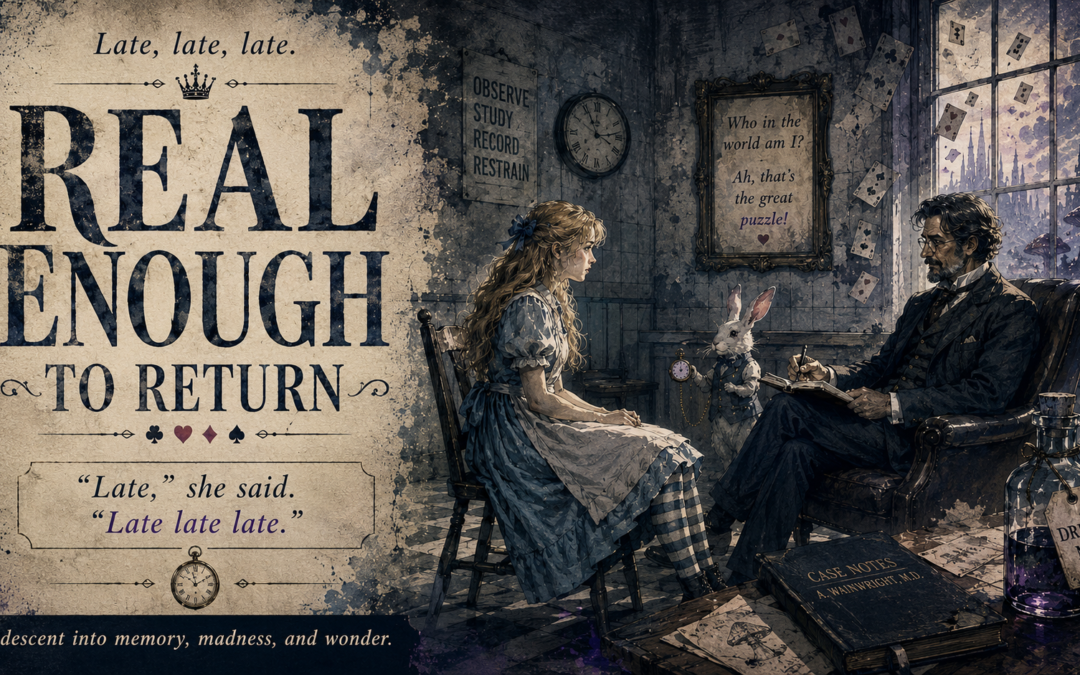
“Late,” she said. “Late late late.”
Her sister’s name was given. The family’s address. The family’s standing. The proper apologies were made, and the proper kind of money appeared, quietly, as money always did.
It bought a kind room with a lock no one called a lock.
“A rest,” the matron said. “For her safety.”
Safety, Alice thought, had a particular sound. It sounded like a door closing gently.
The room was whitewashed into harmlessness: white walls, white curtains, a white porcelain jug of water. Even the fire behind the grate seemed polite, as though it had been trained not to leap too high. The window was clean enough to throw her face back at her, pale and sharp, as if someone had redrawn her in thinner ink.
A man entered carrying a notebook and an attentive face. Not old, not young—professionally in between. A watch hung from his waistcoat, and every so often his fingers moved toward it, not to consult the hour but to reassure himself that time still obeyed him.
“Miss Liddell,” he said, sitting opposite her. “I’m Doctor Wainwright. You’ve had an experience.”
Alice looked at his pen. It had a nib fine enough to write a person into smaller pieces.
“I’ve had several,” she said.
He smiled. It was the sort of smile designed to invite cooperation.
“Can you tell me what happened yesterday?”
“It’s no use going back to yesterday,” Alice said. “I was a different person then.”
His pen paused only briefly, then resumed.
“I was sitting with my sister,” she added, because beginnings were expected. “And then a rabbit went by.”
“A rabbit,” he repeated.
“It was dressed.”
Something in his face brightened—not surprise, but recognition. She had given him the right species of madness.
“Are you certain it was a rabbit?”
“Are you certain you are a doctor?” Alice replied.
The question came out too quickly. At once she regretted it. The room seemed suddenly full of invisible listeners.
“My concern,” he said gently, “is that you may have become confused.”
“Most everyone’s mad here,” Alice said. “They simply agree on which madness to call sensible.”
That made him look up.
“Tell me about the rabbit.”
“He had a waistcoat,” Alice said, grateful for the familiar thread. “And a watch. And he was late.”
“Curiouser and curiouser. Lateness,” the doctor murmured, writing. “A symbol, perhaps. Pressure. Anxiety.”
“It wasn’t a symbol,” said Alice. “It was the law of the place. To be late was to be wrong. To be wrong was to be punishable.”
“By whom?”
She hesitated.
“The Queen.”
His pen moved faster. “A maternal figure. Authority.”
“No,” Alice said, and now her voice sharpened. “Not a person. A principle. A way the world excused cruelty by calling it order.”
He leaned forward. “And how was this justice carried out?”
“With rules,” said Alice. “With ceremony. With smiles. With paper. The axe was only theatre.”
At that, his pen blotted. Only a little, but enough. He pressed his handkerchief to the page and continued.
“And the rabbit led you where?”
“Down.”
The word alone was enough to wake the memory in her body. Her stomach gave a small, treacherous turn.
“Did you strike your head?”
“No.”
“Did you consume anything? Any medicine? Any confection?”
There it was. The little mechanism of reason. Find the draught, and the dream could be folded shut. Label the disturbance, and the world might be returned to its shelf.
“There were things to drink,” Alice said. “And things to eat.”
“And did you?”
“Yes.”
“What happened?”
“I changed.”
His voice gentled, as one speaks to children and the dying.
“Children often feel they are changing.”
“No,” Alice said. “I changed size.”
He paused, kindly. “Miss Liddell, the mind can produce vivid distortions under stress and intoxication.”
“It wasn’t distorted,” she said. “It was flexible. Doors could be too small and then not. Bodies too large and then not. Identity could become a question.”
He studied her for a moment.
“Who are you?”
“Who in the world am I? Ah, that’s the great puzzle!”
The clock on the mantel ticked three quick beats and stopped.
Doctor Wainwright glanced at it. After a moment it resumed, perfectly and politely, as though nothing had happened. He cleared his throat.
“And did this place frighten you?” he asked.
Alice thought of questions with no right answers, of rules that shifted, of the exhausting labour of trying to remain oneself in a world that profited from making you anything but.
“Yes,” she said.
“And did it delight you?”
That was more dangerous.
“Yes,” she said softly. “Because for once the rules were honest. They admitted they were arbitrary.”
His pen stopped.
Then, softly: “Was it real?”
Alice looked at his notebook and understood the trap. Yes, and he would confine her. No, and he would dismiss her.
“It was real enough,” she said, “to change me.”
He gave her a look so gentle it frightened her more than the questions.
“And now,” he said, “you are back. You are safe.”
Safe, thought Alice, and heard again the soft click of the lock.
The doctor lowered his eyes to his notebook and turned the page.
There, impressed into the paper beneath his neat black lines, was a sentence he had not written.
He stilled.
Alice watched the small failure of composure around his mouth.
Slowly, as if afraid to disturb it, he lifted the page to the light.
The words remained.
REAL ENOUGH TO RETURN.
Doctor Wainwright shut the notebook too quickly.
The fire crackled. The clock ticked. Outside, a bird called.
And then, very faintly, from somewhere beneath the floorboards, came the sound of something small and hurried moving in the dark.
A voice followed, thin with panic and politeness:
“Oh dear. Oh dear.”