
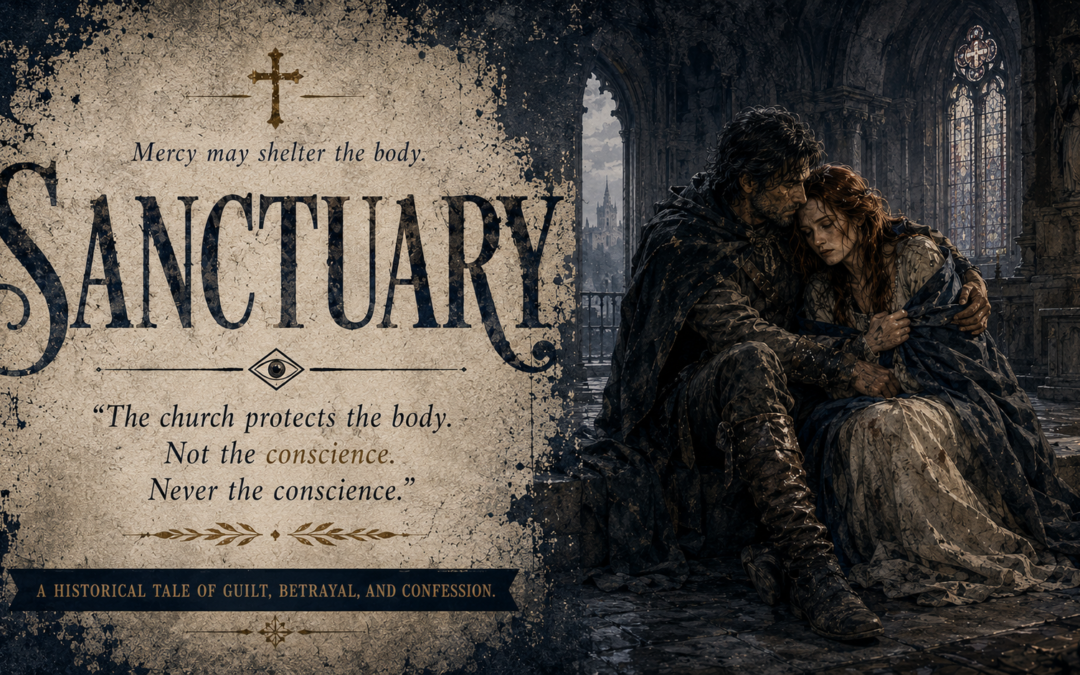
The bell for curfew had long since fallen silent, yet John de Maltone still heard it in his blood.
It seemed to go on tolling beneath the vaulted dark of St Helen’s, deep and slow, as though the stone itself remembered the hour when honest folk had barred their doors and drawn in from the streets, and he had gone instead to his own house with murder in his hand.
He sat against a pillar in the nave, his legs stretched out before him, his back stiff with cold. A single candle guttered before the rood, bowing and righting itself in the draught. Beyond it, the church opened upward into shadow. The sisters had withdrawn. No voice spoke in the dark. Yet the silence of holy places was never true silence. It was old beams settling, mice in the rushes, a woman shifting on the flags three yards away who would not sleep and would not look at him.
Juliana sat with her knees drawn beneath her gown, her face turned from him. Her hair, unbound in their flight, fell over one cheek and shone like tarnished copper in the candlelight. At intervals she pressed both hands to her mouth, not weeping, not praying, only holding herself shut.
John studied her profile and saw again what he had seen when he entered the house: the curve of her shoulder in the bed, the loosened lacing at her throat, the dark head of Edmund de Brekkles bent toward her upon his own pillow.
He shut his eyes.
The image did not dim. Edmund’s bare chest, white in the half-light. Juliana turning, startled rather than afraid. The smell of rushes, sweat, wine, and ash from the hearth. Then the chaplain’s mouth opening, not to plead, but to speak John’s own name with affront in it.
“Do not,” Juliana said.
John opened his eyes. She had not turned toward him.
“I said nothing.”
“You stare as though you mean to ask whether I repent. Or blame you. Or fear Hell more than the sheriff.”
At length he said, “I do not know what face I make.”
“Then that is one true thing tonight.”
His hands lay open on his knees. He had scrubbed them at the basin in the church porch until the skin reddened, but beneath the nails he still imagined darkness.
He had burst through the side door dragging Juliana with him by the wrist, both of them stumbling over the threshold while the sacristan shouted and a novice cried out in fright. Sanctuary, John had said, sanctuary, and the word had spread through him like fever. He had believed in the threshold. Believed that once he crossed into holy ground, the worst would stop there.
But the body remained where he had left it.
Edmund de Brekkles, chaplain, sprawled crookedly beside the bedstead with one hand over his belly as though still trying to keep the life inside him.
“He was not shriven,” John said suddenly.
Juliana gave a short, bitter laugh. “Now you think of shriving?”
“He died quickly.”
“You do not know that.”
“He spoke once.”
“He cried out.”
John looked at her then, because there was something in her voice he had not heard before. Not fear, not anger. Something harder.
Juliana turned to face him at last. In the uncertain light her eyes seemed black. “He said your name. So now you tell yourself there was honour in it. Man against man. But you saw me first, John. Do not lie to your own soul before the altar. You saw me, and it was I that made you strike.”
A draught moved through the nave. The candle bent low, recovered.
John rose too quickly and went a few paces into the aisle. His boots rang on stone, then dulled in old rushes. Above him, painted saints stared down from the dark beams with faces faded to soft blurs. He thought of kneeling. He could not.
Outside, beyond the church wall, a dog barked and was answered by another. Then came voices, distant and rough. Men at the gate perhaps. Watchmen. Or only neighbours who had heard and come to mutter over the tale. London never slept entirely. It simply changed witnesses.
When he was a boy, his mother had told him that sanctuary was God’s mercy made visible in the world. Even sheriffs must wait. A hunted man could cling to the altar and for a time no hand might lawfully seize him. It was not innocence the Church protected, she had said, but the chance for the soul to prepare itself.
He had not understood then why such mercy should be given to the guilty. He understood it less now.
He heard Juliana behind him. “Come away from there. You look as though the wall might open and swallow you.”
“I almost wish it would.”
“That is cowardice.”
He turned. “And what would you call what we did?”
“What you did,” she said. “Be exact.”
She had risen and gathered her cloak around herself. For the first time he saw how cold she must be. In his rage he had dragged her half dressed into the street.
He took off his outer coat and held it toward her.
She looked at it, then at him. “You think that balances anything?”
“No. Take it.”
After a moment she did.
She wrapped it around herself without thanks. It hung too large on her, smelling of wet wool and smoke and him. John watched her hands disappear into the sleeves and felt such a violent tenderness that he almost cried out. That was the worst of it, perhaps. Not merely that he had killed a man, but that the thing between them had survived the murder and still moved in him.
“I did not mean to kill him,” he said.
Juliana tilted her head. “No man ever does, after.”
“I went there to confront him. To have him out of my house.”
“Your house,” she repeated. “Yes. There it is.”
“It was my bed.”
“And I was your wife? Your servant? Your property?”
He flinched. “I never said so.”
“You need not say a thing if you carry it in every step.”
He wanted to deny it, but the denial withered. In the first red blaze of seeing them together, all the words in his head had been words of possession. Mine. My house. My hearth. My honour.
The church door boomed once beneath a heavy knock.
Both of them froze.
Another knock followed, then a voice calling from outside, muffled by timber and distance. Formal. John could not catch the words.
Juliana closed her eyes. “They know.”
“Of course they know.”
A third knock. Then silence.
“Will they come in?” John asked.
“No.”
“How long?”
“Long enough.”
The answer shook him more than if she had said dawn. Time in the church no longer moved forward but deepened around them. He sank down again at the foot of the pillar, suddenly weak.
“I saw the knife before I remember taking it,” he said into the dark.
Juliana did not answer.
“It was on the table by the bed. He must have brought it off the street and laid it there carelessly. I remember the cup overturned. Wine on the boards. His stocking half off at the ankle. Such foolish things. I thought, for one blink, that if I held the blade before him he would rise and go. But he looked at me as though I were filth on his hem.”
Juliana’s face did not change, yet he felt her listening.
“And then there was no thought,” John whispered. “Only force. My arm knew before I did.”
He had expected confession to lighten him. It did not. The words lay between them like more blood.
Juliana drew the coat tighter around her. “He looked at everyone so. Even when he smiled.”
John stared at her.
She looked away. “Do not make too much of that. Dead men are easy to accuse.”
“You cared for him.”
“I may have.” Her voice thinned, then hardened again. “Or cared for what he represented. A man set apart. A man who could hear sins, speak Latin, carry God upon his tongue, and still hunger like any butcher. We all wanted from him what he could not be.”
Near dawn the church changed. The darkness did not lift so much as loosen. The beams greyed. Shapes emerged: benches, screens, the pale line of the nave arch, Juliana’s face hollowed by exhaustion. Somewhere in the cloister a bell was rung once, softly.
Footsteps approached from within the church precinct, measured and official.
John rose.
The door opened. A clerk entered first, then another man in sober dress whom John knew by sight from ward business. Behind them lingered a priest with a face worn almost smooth by long habit of hearing misery. No one came close enough to touch.
The clerk unrolled a strip of parchment.
John understood then that sanctuary had not stopped judgment. It had merely made space for it to arrive with ceremony.
The priest spoke first, not unkindly. “Have you considered your soul?”
John looked past him to the door, where morning showed in a narrow line, colourless as old bone.
All night he had thought of escape in bodily terms: rope, cell, blade. Yet now another horror rose in him. To name the deed aloud would fix it in the world. His own voice would build the thing that would follow him to the sea and beyond it. He would be the man who had done this wherever he went.
And still, beneath that dread, another truth moved: he had already become him.
The church protects the body, he thought. Not the conscience. Never the conscience.
When he tried to speak, no sound came. He swallowed and began again.
“My name is John de Maltone,” he said, and heard the words fall into the morning air like stones into deep water. “I confess that I slew Edmund de Brekkles in my house after curfew.”
Juliana made no sound. The clerk’s pen scratched steadily.
As the formal words continued around him, assigning roads, days, the port he must make for, the terms by which he would quit the realm, John scarcely heard them. Exile. Abjuration. Never return on pain of death. The language moved with the calm certainty of liturgy.
When at last they led him to the threshold, he paused.
Inside lay the church: stone, candle smoke, the place where no hand had seized him. Outside lay the city, waking under a low white sky. The frost had silvered the yard. Beyond the gate, London waited in all its ordinary cruelty: shutters opening, women with baskets, gossip travelling faster than carts. Somewhere in that waking city Edmund’s body was cooling among people who would cross themselves over it and whisper their judgments. Somewhere too perhaps, God had already judged more exactly than any of them.
John stepped forward.
The cold struck his face like water. Behind him, within the sanctuary, the door remained open for one breath longer, then closed with a sound at once gentle and final.
He did not look back again.
Bibliography
Historical facts that help bring the story to life
The medieval London murder case of Edmund de Brekkles, a chaplain, is where this story draws its roots. It was in 1324 that this chaplain met his demise at the hands of John de Maltone and Juliana Aunsel, and the events surrounding it are the real deal – at least, as real as they can be from some 700 years ago. To flesh out those events, I took a close look at the notes from the coroner’s roll and the summaries of an actual trial. The bits about what was – and wasn’t – allowed within the framework of sanctuary and also the use of coroners’ rolls as records of sudden or suspicious deaths come straight from those sources.
The bits that I had to invent to turn history into a story
The parts that you don’t see in any historical record, like what the characters actually said, what they were thinking, and even what they saw or felt, all had to be pieced together by me. Same goes for the pace of that long night inside St Helen’s, the dialogue and all the inner workings of the emotional stakes. I tried to keep it as tied to fact as possible – even when it came to what the church St Helen’s actually looked like – but let’s be real, most of that ‘what happened next’ stuff? I made it all up.
Sharpe, R.R. (ed.) (1913) Calendar of Coroners’ Rolls of the City of London, A.D. 1300–1378. London: R. Clay and Sons. Available at: Internet Archive.
University of Cambridge Violence Research Centre (n.d.) The Coroners’ Rolls and their Significance. Available at: Medieval Murder Maps project.
Cybulskie, D. (2014) ‘Medieval London Murders: Edmund de Brekkles’, https://www.medievalists.net/2014/06/medieval-london-murders-edmund-de-brekkles/
Fordham University (n.d.) St Helen’s Bishopsgate. In: Medieval London Sites.
University of Cambridge (2023) ‘Medieval Murder Maps’, University of Cambridge.